
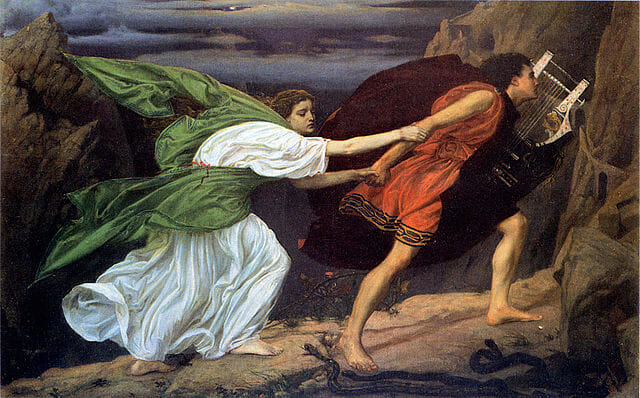
The theme of good and evil is one of the central topics in world literature. It allows authors to explore moral and philosophical questions, the psychological mechanisms of personality, and the social consequences of human actions. Good and evil are not always manifest in obvious ways; they often intertwine within a character, creating complex moral and psychological conflicts.
This theme has been explored in literature across different eras — from medieval Europe to contemporary global prose. This essay examines works by Dante Alighieri (The Divine Comedy), William Shakespeare (Macbeth), Mary Shelley (Frankenstein), a Western adaptation of Fyodor Dostoevsky’s Crime and Punishment, and contemporary American author John Green (The Fault in Our Stars). These works demonstrate how writers from various cultures and epochs have explored the nature of evil and virtue, the consequences of moral choice, and the complexity of human psychology.
Good and Evil in Classical Literature
In classical literature, good and evil are often presented as absolute categories, and their opposition forms the basis for moral and philosophical storytelling.
Example: Dante Alighieri, The Divine Comedy
In The Divine Comedy (1308–1320), Dante explores the concepts of good and evil through the protagonist’s journey through Hell, Purgatory, and Paradise. Hell is depicted as a place of punishment for sinners, Purgatory as a space for redemption, and Paradise as the realm of virtue.
Evil here symbolizes the violation of moral law, selfishness, and passions that lead to the destruction of the individual. Good, by contrast, is associated with order, love, and moral perfection. Dante demonstrates that moral choice and personal responsibility determine a person’s fate.
Symbolism of Good and Evil
Through allegories and symbols, Dante conveys universal values. For example, Lucifer at the center of Hell embodies absolute evil, while encounters with the righteous illustrate ideals of human virtue. This artistic approach allows readers to reflect on philosophical and moral aspects of good and evil.
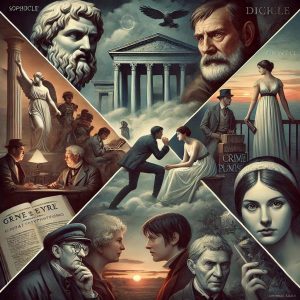 The Tragic Conflict of Good and Evil
During the Renaissance and Baroque periods, literature explored good and evil through the internal conflicts of characters, moral dilemmas, and the consequences of ambition.
Example: William Shakespeare, Macbeth
In the tragedy Macbeth (1606), good and evil are manifested through ambition, power, and moral choice. Macbeth is initially presented as a noble warrior, but the witches’ prophecy awakens his hidden thirst for power. His decision to murder the king is an act of evil, violating both personal and social morality.
Shakespeare demonstrates that evil often originates within a person as a result of internal passions and ambition. Good is embodied in characters like Banquo or Macduff, who uphold moral principles even in difficult circumstances.
Psychological Dynamics
The tragedy of Macbeth illustrates the psychological nature of evil: internal doubts, self-justification, and gradual moral decay. Good here is not abstract but manifests through actions aligned with conscience and ethical law.
Evil as a Result of Scientific and Social Experimentation
With the advent of modernity, literature began exploring evil as a consequence of human reason, scientific progress, or social conditions.
Example: Mary Shelley, Frankenstein
In Frankenstein (1818), evil emerges through the creation of artificial life and the consequences of neglecting moral responsibility. Victor Frankenstein seeks scientific glory, but his experiment leads to the suffering and death of others.
Evil here is not inherent wickedness but results from the disregard of ethical norms and social responsibility. Good manifests through the humanity and compassion of other characters, such as Elizabeth, who strive to help and protect.
Social and Moral Consequences
Shelley shows that human actions, even motivated by scientific advancement or personal ambition, can have destructive outcomes. The theme of good and evil is explored through responsibility, consequences, and moral duty.
Good and Evil in Psychological Literature
In the nineteenth century, literature began examining moral categories through the psychological complexity of characters and social conditions.
Example: Crime and Punishment (Western adaptation)
In a Western adaptation of Dostoevsky’s work, a young man commits murder, believing it justified for a “higher purpose.” However, awareness of consequences, guilt, and social pressure gradually transform his character.
Good manifests through personal remorse and the pursuit of moral reevaluation. Evil is present in the initial act of violence and the justification of his actions. The psychological dynamics of the protagonist demonstrate how internal conflict and social critique shape moral development.
Good and Evil in Contemporary Literature
In contemporary world literature, the theme of good and evil is often explored through everyday life, personal relationships, and psychological experiences, frequently without abstract philosophical framing.
Example: John Green, The Fault in Our Stars
In The Fault in Our Stars (2012), evil is manifested not as deliberate actions by characters but through unavoidable circumstances: illness, death, and suffering. Good is expressed through human love, friendship, moral support, and the desire to help others.
Green illustrates that evil may not always be conscious, while good is found in small yet meaningful deeds. The narrative emphasizes the moral complexity of a world in which human choice and empathy produce tangible consequences.
Philosophical and Emotional Dimension
Contemporary literature explores the psychological and emotional dimensions of good and evil, showing how human reactions, moral principles, and empathy shape the ethical fabric of society.
Universal Patterns
An analysis of works from different eras reveals several universal patterns:
-
Evil often manifests as a violation of moral and ethical norms, personal ambition, or neglect of responsibility.
-
Good is associated with moral principles, compassion, and adherence to ethical law.
-
Internal conflicts in characters allow a deeper understanding of the psychology of evil and paths to redemption.
-
Historical, social, and cultural context shapes the nature of evil and the expression of good.
-
Literary works enable the exploration of the consequences of choice and moral dilemmas relevant to all eras.
Key Takeaways
-
Good and evil remain universal categories in literature, relevant in every era.
-
Complex characters allow the exploration of psychological and social aspects of morality.
-
Historical and cultural context determines how evil and good are manifested.
-
Literature shows that moral choice affects both individuals and society.
-
Different periods offer diverse artistic approaches to portraying good and evil, from absolute opposition to psychological and social complexity.
Conclusion
The theme of good and evil in world literature demonstrates the universality and complexity of moral categories. From Dante to contemporary authors, writers explore the consequences of moral choice, the psychological mechanisms of personality, and the influence of social circumstances. Good and evil intertwine, creating profound artistic and philosophical meanings. Studying this theme allows readers to reflect not only on literature but also on human morality, the psychology of actions, and the social consequences of deeds, making these works relevant across time.
Leave a Reply